This article is about material waste. For the medical condition, see Wasting. For wasteful government spending, see government waste. For other uses, see Waste (disambiguation).

Waste and wastes are unwanted or unusable materials. Waste is any substance which is discarded after primary use, or it is worthless, defective and of no use.
Examples include municipal solid waste (household trash/refuse), hazardous waste, wastewater (such assewage, which contains bodily wastes (feces and urine) andsurface runoff), radioactive waste, and others.
Types of waste
Generally, waste could be liquid or solid waste. Both of them could be hazardous. Liquid and solid waste types can also be grouped into organic, re-usable and recyclable waste.
Let us see some details below:
Generally, waste could be liquid or solid waste. Both of them could be hazardous. Liquid and solid waste types can also be grouped into organic, re-usable and recyclable waste.
Let us see some details below:
 Liquid type:
Waste can come in non-solid form. Some solid waste can also be converted to a liquid waste form for disposal. It includes point source and non-point source discharges such as storm water and wastewater. Examples of liquid waste include wash water from homes, liquids used for cleaning in industries and waste detergents.
Solid type:Solid waste predominantly, is any garbage, refuse or rubbish that we make in our homes and other places. These include old car tires, old newspapers, broken furniture and even food waste. They may include any waste that is non-liquid.
Hazardous type:Hazardous or harmful waste are those that potentially threaten public health or the environment. Such waste could beinflammable (can easily catch fire), reactive (can easily explode),corrosive (can easily eat through metal) or toxic (poisonous to human and animals). In many countries, it is required by law to involve the appropriate authority to supervise the disposal of such hazardous waste. Examples include fire extinguishers, old propane tanks, pesticides, mercury-containing equipment (e.g, thermostats) and lamps (e.g. fluorescent bulbs) and batteries.
(More on hazardous waste here)
waste disposal. Removing and destroying or storing damaged, used or other unwanted domestic, agricultural or industrial products and substances. Disposalincludes burning, burial at landfill sites or at sea, and recycling.
3FLARES

Industrialized nations are grappling with the problem of expeditious and safe waste disposal. Non-biodegradable and toxic wastes like radioactive remnants can potentially cause irreparable damage to environment and human health if not strategically disposed of.
Though waste disposal has been a matter of concern for several decades, the main problem has been taking massive proportions due to growth in population and industrialization, the two major factors that contribute to waste generation. Though some advancement is being made in waste disposal methods, they are still not adequate. The challenge is to detect newer and unhazardous methods of waste disposal and put these methods to use.
Below we will venture into six effective waste disposal methods.
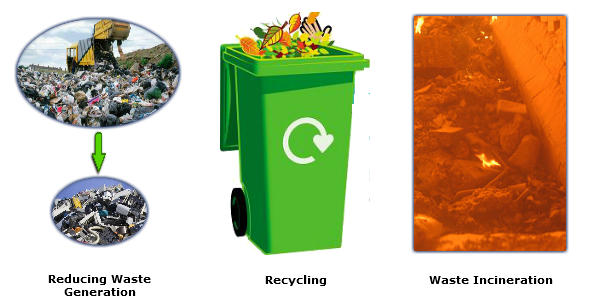
1. Preventing or reducing waste generation: Extensive use of new or unnecessary products is the root cause of unchecked waste formation. The rapid population growth makes it imperative to use secondhand products or judiciously use the existing ones because if not, there is potential risk of people succumbing to the ill effects of toxic wastes. Disposing off the wastes will also assume formidable shape. A conscious decision should be made at the personal and professional level to judiciously curb the menacing growth of wastes.
2. Recycling: Recycling serves to transform the wastes into products of their own genre through industrial processing. Paper, glass, aluminum, and plastics are commonly recycled. It is environmental friendly to reuse the wastes instead of adding them to nature. However, processing technologies are pretty expensive.
3. Incineration: Incineration features combustion of wastes to transform them into base components, with the generated heat being trapped for deriving energy. Assorted gases and inert ash are common by-products. Pollution is caused in varied degrees dependent on nature of waste combusted and incinerator design. Use of filters can check pollution. It is rather inexpensive to burn wastes and the waste volume is reduced by about 90%. The nutrient rich ash derived out of burning organic wastes can facilitate hydroponic solutions. Hazardous and toxic wastes can be easily be rid of by using this method. The energy extracted can be used for cooking, heating, and supplying power to turbines. However, strict vigilance and due diligence should be exercised to check the accidental leakage of micro level contaminants, such as dioxins from incinerator lines.

4. Composting: It involves decomposition of organic wastes by microbes by allowing the waste to stay accumulated in a pit for a long period of time. The nutrient rich compost can be used as plant manure. However, the process is slow and consumes a significant amount of land. Biological reprocessing tremendously improves the fertility of soil.
5. Sanitary Landfill: This involves the dumping of wastes into a landfill. The base is prepared of a protective lining, which serves as a barrier between wastes and ground water, and prevents the separation of toxic chemicals into the water zone. Waste layers are subjected to compaction and subsequently coated with an earth layer. Soil that is non-porous is preferred to mitigate the vulnerability of accidental leakage of toxic chemicals. Landfills should be created in places with low groundwater level and far from sources of flooding. However, sufficient number of skilled manpower is required to maintain sanitary landfills.
6. Disposal in ocean/sea: Wastes generally of radioactive nature are dumped in the oceans far from active human habitats. However, environmentalists are challenging this method, as such an action is believed to spell doom for aquatic life by depriving the ocean waters of its inherent nutrients.
Effective waste disposal calls for concerted efforts from all, no matter how anxious or worried they may be about our environment.


No comments:
Post a Comment